
The European Transport Sector runs on drivers who move freight across borders daily, often under tight schedules and tighter compliance checks.
EU rules keep that mobility workable by setting common standards for pay protections, road safety, and competition, even when a trip crosses multiple countries in one week.
Most of the day-to-day impact shows up in working time limits, how border crossings are recorded, and what paperwork needs to be ready during roadside controls. Missteps usually cost carriers money fast, and repeated issues can trigger deeper audits.
Driver Roles and Working Conditions
A lot of confusion starts here because “driver role” isn’t only about steering the truck. Legal duties shift depending on where the transport happens, how long the stay lasts, and what type of operation gets performed.
Core Roles On International Runs
Linehaul and long-distance drivers typically handle multi-day routes, border crossings, and handovers at hubs. Regional distribution drivers often operate near terminals but still cross borders in dense corridors like Benelux, the Alpine routes, or Central Europe.
Specialists add another layer: ADR drivers (dangerous goods), temperature-controlled operators, and car transporters face extra technical checks, but the baseline social rules stay the same.
Regulators focus on predictable controls rather than job titles. Enforcement usually asks a simple question: Did the driver and operator follow the common EU rules for time, documentation, and posting obligations?
Driving and Break Rules That Shape The Day
Daily planning lives and dies by driving and rest times. EU social rules set a daily driving cap of 9 hours, with limited extensions to 10 hours on no more than two days in a week.
Break rules also matter in a very practical way:
- after 4.5 hours of driving,
- A break of at least 45 minutes is required unless a rest period starts.
Weekly limits add another ceiling. Total weekly driving time is capped, and fortnight limits stop “two-week sprints” from becoming the norm.
The European Commission’s road transport social provisions and the Eur-Lex summary of the driving time framework remain the safest references for the baseline numbers, since member state enforcement aligns with those texts.
The EU Mobility Package and Why It Matters
This heading carries the whole compliance logic, so clarity matters more than detail overload. Operators who treat these rules as “paperwork” usually end up learning them through fines.
The EU Mobility Package integrates social rules, market access rules, and enforcement tools to ensure that a driver’s rights and a carrier’s obligations don’t change significantly at each border.
Fair competition sits at the center: a carrier established in one country should not undercut competitors by using lower labour standards or bending the rules on cabotage. Driver protection is the other pillar, covering rest conditions and enforcement against abusive schedules.
Posting Rules In Real Operations
Posting rules apply when work is effectively performed in another country’s labour market, even for a short time. Drivers are considered posted in several common cases, including cabotage and cross-trade patterns.
A simple way to avoid mistakes is to label trips correctly during dispatch planning.
Cross-trade operations occur when a carrier established in one country moves goods between two countries, or between an EU country and a non-EU country, and the employer is not established in either country.
Posting Also Changes the Pay Logic
Remuneration requirements shift to the host country’s rules for the relevant period, meaning allowances, minimum pay elements, and certain conditions can differ trip to trip. Member states publish national guidance, and the EU’s road transport posting framework points operators to those country-level references.
Cross-Border Rules and Compliance
Cross-border freight is routine in Europe, yet enforcement assumes non-compliance is normal unless evidence is available. Paperwork, digital records, and correct route classification become the “proof layer” when an inspection happens.
Cabotage and Market Fairness
Cabotage restrictions exist to stop permanent domestic competition by carriers established elsewhere. Cabotage refers to domestic transport inside a host country on a temporary basis by a non-resident carrier.
Rules define what counts as permitted cabotage activity and how it must be sequenced after an international entry movement, and those limits are enforced actively in high-traffic countries.
Compliance here is not theoretical. Inspectors often check the chain of operations using consignment notes and tachograph border data to validate timing and location.
Smart Tachograph Rules and What “Smart 2” Changes
Digital enforcement has accelerated because paper checks do not scale in a high-volume internal market. The second-generation smart tachograph adds features built for posting and cabotage enforcement, such as automated border crossing recording and location data related to loading or unloading events.
That is why the Smart 2 tachograph has become a central compliance tool. European Commission tachograph guidance explains the purpose clearly: stronger enforcement capability across borders, not a new driving-time rule set. National transport authorities and roadside units then use those features to match declared operations against recorded movements.
Tachograph compliance is also behavioural. Driver training on manual entries, correct mode switching, and card handling often prevents “accidental violations” that still trigger penalties.
Document Pack For Roadside Checks
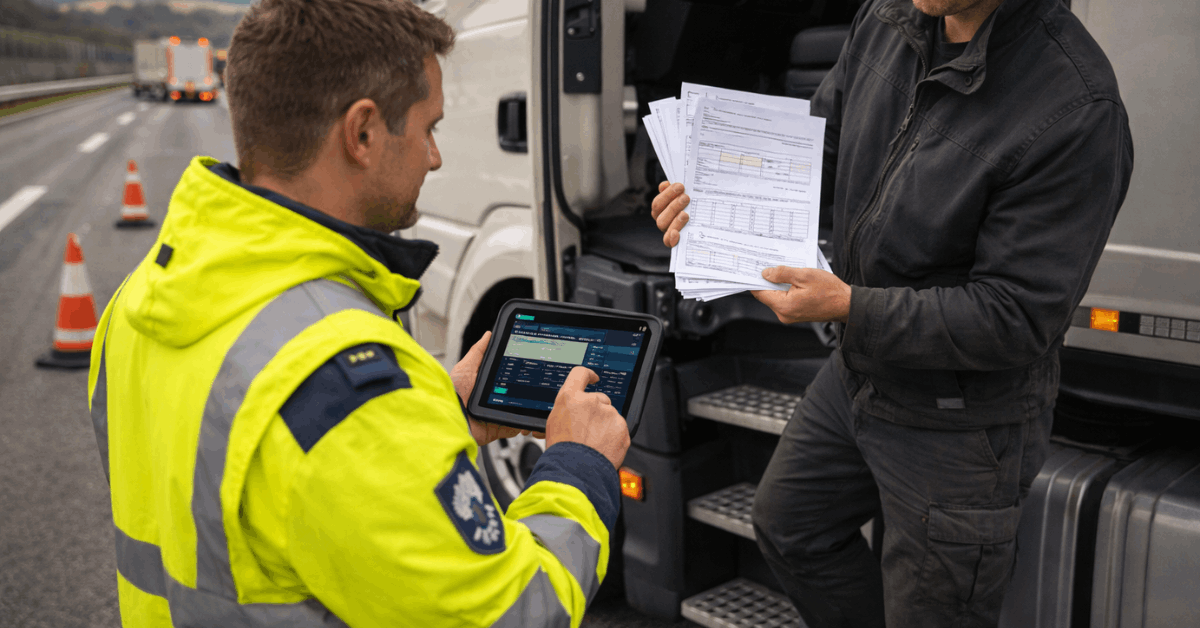
A clean document pack saves time, reduces escalation risk, and signals professionalism. Most checks look for a consistent story across documents and digital records.
- A copy of the posting declaration, held electronically or on paper, ready during the posted period.
- Evidence of the transport operation in the host country, such as consignment notes or equivalent proof.
- Tachograph records relevant to the period under control, aligned with the trip and operation sequence.
- Any requested proof after the posting can include payslips, proof of payment, time sheets, the employment contract, and supporting evidence that the operation occurred where declared.
- Authorities can request documents after the operation as well, so record retention systems matter as much as the driver’s on-the-road pack.
Third-Country Drivers and Extra Scrutiny
Non-EU drivers can work legally, yet enforcement tends to check documentation more aggressively because fraud risks exist around driver attestations and certificates.
Valid work and driving documentation must align with the carrier’s establishment, the route, and the applicable national and EU rules.
Operationally, risk drops when carriers standardise onboarding: document verification, certificate validation steps, and periodic re-checks. A single expired or inconsistent document can turn a normal inspection into a full compliance event.

Enforcement and The Role Of EU Bodies
Rules only matter if enforcement is consistent. Europe has pushed toward coordinated checks because fragmented enforcement encourages rule shopping.
The European Labour Authority supports cooperation between member states, including coordinated inspections and cross-border enforcement work related to labour mobility.
Road transport falls within that broader mandate because posting rules and working conditions cross borders, as drivers do. National enforcement bodies still issue penalties, yet the direction of travel is clearly toward more coordinated actions, shared intelligence, and quicker verification.
Safety and Future Trends In Road Transport
A compliance-focused view can miss what is changing in the background: safety tech and decarbonisation targets are reshaping fleet investment, job requirements, and operating models.
EU vehicle safety policy has pushed the adoption of driver-assist features, including emergency braking and intelligent speed assistance, especially on new vehicle types and updated approvals. Training needs follow that trend because driver responsibility does not diminish when assistance is available.
Climate Policy is the Other Big Pressure
The Sustainable and Smart Mobility Strategy sets a long-term goal of cutting transport-related greenhouse gas emissions by 90% by 2050, aligned with the European Green Deal direction.
That pushes fleets toward lower-emission vehicles, smarter routing, and better load efficiency.
Hiring and training also shift, since drivers increasingly need comfort with digital tools, eco-driving practices, and compliance tech that records far more operational detail than older systems ever did.
Last Thoughts
EU road freight stays profitable when compliance is treated like route planning, not admin cleanup. Smart tachograph data, correct trip classification, and a ready document pack reduce roadside friction and keep small errors from snowballing into audits.
Payment and posting obligations need the same discipline, since enforcement often checks consistency across declarations, tachograph records, and consignment notes.
Future-facing fleets also need to keep pace with safety tech and climate-driven operating changes, because digital controls and driver expectations keep tightening across Europe.